

The term RWU UAR has been appearing more frequently across educational, technological, and research-related discussions. However, many readers are left confused about what it actually means. Is RWU UAR a system? A framework? A university reference? Or an access management concept?
This guide breaks down the RWU UAR meaning, explains how it works in different contexts, and explores its applications in education, technology, research, and enterprise environments—all in clear, simple language.
What Is RWU UAR? (Clear, Unambiguous Definition)
RWU UAR is an umbrella term commonly used to describe a role-weighted access and unified resource framework. In simple terms, it refers to a structured approach for managing user access rights, resources, and permissions based on defined roles and responsibilities.
Because RWU UAR is used in multiple industries, its meaning can change depending on context. education, it often relates to student access management systems. In technology, it may refer to user access requests and role-based access control. In academic discussions, it can also be confused with university acronyms, such as the University of Rawalpindi or the University of Arid Agriculture.
Understanding what RWU UAR is requires context, which is why clarity is essential from the start.
Origin and Evolution of the RWU UAR Concept
The RWU UAR framework did not emerge from a single institution or software platform. Instead, it evolved organically as organizations struggled to manage complex access systems in digital environments.
Early access systems were manual, rigid, and difficult to scale. As cloud-based platforms, digital learning environments, and enterprise automation systems grew, organizations needed a more flexible solution. RWU UAR evolved to address these challenges by combining:
-
Role-based access logic
-
Unified resource management
-
Automated permission workflows
Over time, RWU UAR became relevant in modern education systems, research institutions, and enterprise IT infrastructures.
Different Meanings of RWU UAR by Context
RWU UAR in Education Systems
In education, RWU UAR in modern education focuses on controlling who can access digital resources such as learning platforms, course materials, assessments, and administrative systems.
Educational institutions use RWU UAR systems to:
- Assign permissions based on student, faculty, or administrative roles
- Support personalized learning environments
- Secure student information systems (SIS)
- Improve access efficiency across digital campuses
This makes RWU UAR especially useful for universities, colleges, and online learning platforms managing large user populations.
RWU UAR in Technology & Access Management
In technology contexts, RWU UAR is closely associated with user access rights, access request workflows, and role-based access control (RBAC).
Here, RWU UAR systems help organizations:
- Automate user access requests
- Centralize permission management
- Reduce security risks
- Ensure compliance with data protection standards
This version of RWU UAR is commonly used in IT departments, cloud infrastructures, and enterprise software environments.
RWU UAR in Research and Academic Collaboration
Research institutions rely heavily on secure data sharing and controlled collaboration. RWU UAR plays a crucial role by allowing researchers to access sensitive datasets only when authorized to do so.
RWU UAR in research supports:
- Applied research frameworks
- Cross-department collaboration
- Secure academic data access
- Research compliance and auditing
This makes RWU UAR essential in universities, laboratories, and academic research centers.
RWU UAR as an Acronym (Universities & Institutions)
Another reason for confusion is that RWU UAR is sometimes interpreted as a reference to universities, such as Rawalpindi Women University (RWU) and University of Arid Agriculture (UAR).
While these institutions are legitimate, they are not directly related to RWU UAR as a system or framework. This overlap in terminology explains why many users search for “RWU UAR meaning” or “what does RWU UAR stand for.
How the RWU UAR Framework Works (Step-by-Step)
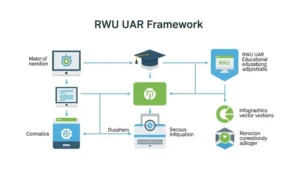
Understanding how RWU UAR works helps clarify its value.
- User Identification – Each user is identified within the system.
- Role Assignment – Roles are assigned based on function (student, faculty, admin, researcher).
- Role Weighting – Permissions are adjusted based on responsibility level.
- Access Requests – Users request access to specific resources.
- Approval Workflow – Automated or manual approval processes validate requests.
- Resource Allocation – Approved users gain controlled access.
- Monitoring & Auditing – Activity is tracked for compliance and security.
This structured flow allows RWU UAR systems to remain scalable, secure, and adaptable.
Key Features of RWU UAR Systems
Modern RWU UAR systems include several important features:
- Role-weighted permissions
- Centralized access control
- Automation of access requests
- Scalability across departments
- Security and compliance monitoring
These features make RWU UAR suitable for both educational institutions and enterprise organizations.
Benefits of RWU UAR in Modern Environments
Educational Institutions
- Improved student data security
- Streamlined access to learning platforms
- Better digital campus management
Researchers and Academics
- Secure collaboration
- Controlled access to sensitive research data
- Improved research workflow efficiency
Organizations and Enterprises
- Reduced manual permission errors
- Faster onboarding and offboarding
- Stronger compliance with regulations
RWU UAR vs Traditional Access Management Models

Compared to traditional access systems, RWU UAR offers:
- Greater flexibility than manual permission systems
- More scalability than static RBAC models
- Better automation and oversight
This makes RWU UAR vs traditional access management a clear upgrade for modern digital environments.
Limitations and Challenges of RWU UAR
Despite its benefits, RWU UAR has limitations:
- Initial implementation complexity
- Training requirements
- Integration challenges with legacy systems
Understanding these challenges helps organizations adopt RWU UAR more effectively.
Real-World Use Cases and Practical Examples
- Universities manage thousands of students and faculty
- Research labs controlling access to confidential datasets
- Enterprises automating employee access to internal systems
These RWU UAR use cases demonstrate its versatility across sectors.
Future Trends and Developments in RWU UAR
Future RWU UAR systems are expected to include:
- AI-driven access decisions
- Advanced analytics
- Deeper cloud platform integration
- Stronger regulatory compliance tools
Frequently Asked Questions About RWU UAR
Is RWU UAR a software or a framework?
RWU UAR is best described as a framework that can be implemented through different systems.
Is RWU UAR only used in education?
No. RWU UAR is widely used in technology, research, and enterprise environments.
What problems does RWU UAR solve?
It simplifies access management, improves security, and reduces administrative workload.
Final Thoughts: Why RWU UAR Matters Today
As digital systems grow more complex, organizations need smarter ways to manage access and resources. RWU UAR provides a flexible, scalable, and secure framework that adapts to modern educational, research, and enterprise needs.
Understanding the true meaning of RWU UAR allows institutions to apply it correctly—and avoid the confusion that currently dominates online discussions.





Leave a Reply